

Edinburgh team helps turn Euclid images into a 3D map of the universe
The European Space Agency released Euclid’s first major batch of observations on 12 November, giving astronomers the raw material for a more detailed 3D map of the universe. Researchers at the University of Edinburgh help turn the telescope’s images into data that scientists can measure and compare.
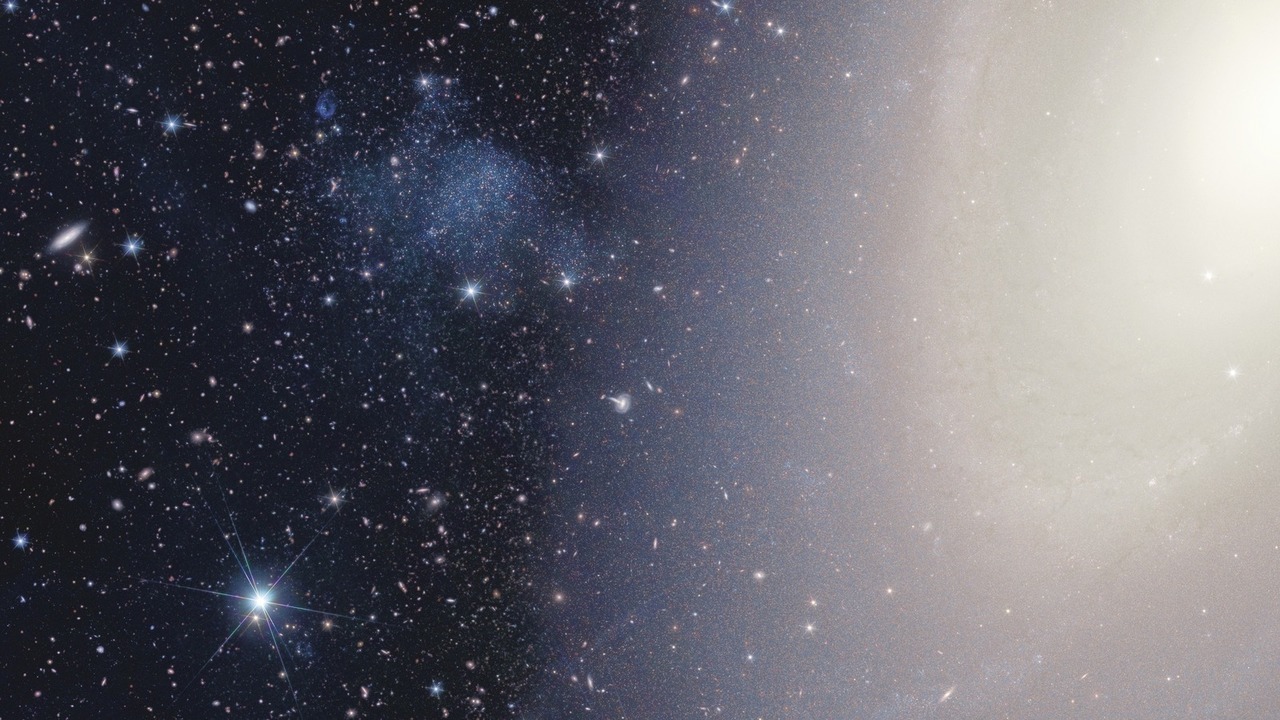
The European Space Agency released Euclid’s first major batch of observations on 12 November, giving astronomers the raw material for a more detailed 3D map of the universe. Researchers at the University of Edinburgh help turn the telescope’s images into data that scientists can measure and compare.
The release, called DR1-Foundation, draws on about 13 months of observations. It covers a patch of sky equivalent in area to about 9,500 full moons. Alongside the wide-field images, ESA released spectra, which record how the light from an object varies with wavelength.
That combination matters because an image alone shows where galaxies lie across the sky. Spectra can help astronomers estimate how far away some galaxies are, giving the map depth. Astronomers can also study how gravity bends the light from distant galaxies, a way to investigate matter that telescopes cannot see directly.
The Edinburgh team helps build the software that processes Euclid’s observations. Its work includes correcting the effects of radiation on detectors and accounting for how the telescope’s optics affect the images. Those corrections matter when the signal astronomers want to measure is a small change in the shape of a galaxy.
The new release gives researchers data to work with now. Edinburgh expects the first cosmology results from the mission in 2027, when researchers can begin testing what the observations say about the distribution of dark matter and the expansion of the universe.
More from BroadKit · Technology & Science